
Sex Offender Checks in Chatham County
The North Carolina State Bureau of Investigation maintains the statewide Sex Offender and Public Protection Registry with information submitted and verified through all 100 county sheriffs. For Chatham County, the state registry is the public search layer and the Chatham County Sheriff's Office is the local registration contact. The registry covers only people whom North Carolina law requires to register. It does not include every sexual offense, every person who committed one, or confidential juvenile adjudications.
Start a Chatham County registry check with the question. An address or nearby search supports neighborhood awareness. A name search can help distinguish a known person, while city, ZIP, and sex registration number filters can narrow the results. Check aliases, physical details, address, registration status, and the qualifying offense instead of relying on one matching name. SBI warns that positive identity ultimately requires fingerprint comparison.
Chatham County Registry Office
The Sheriff's Office handles Chatham County sex-offender registration at 295 West Street in Pittsboro. The direct line is 919-545-7807, and the registration email is ccsosor@chathamsheriff.com. That contact is appropriate for registration and compliance questions, suspected inaccurate local information, or a concern that a person has not registered as required. It is separate from the general court clerk and from the SBI public search interface.
Chatham Registration Contact
Chatham County Sheriff's Office
295 West Street
Pittsboro, NC 27312
919-545-7807
ccsosor@chathamsheriff.com
The SBI registry program page describes the state program and routes readers to public registry and alert resources.
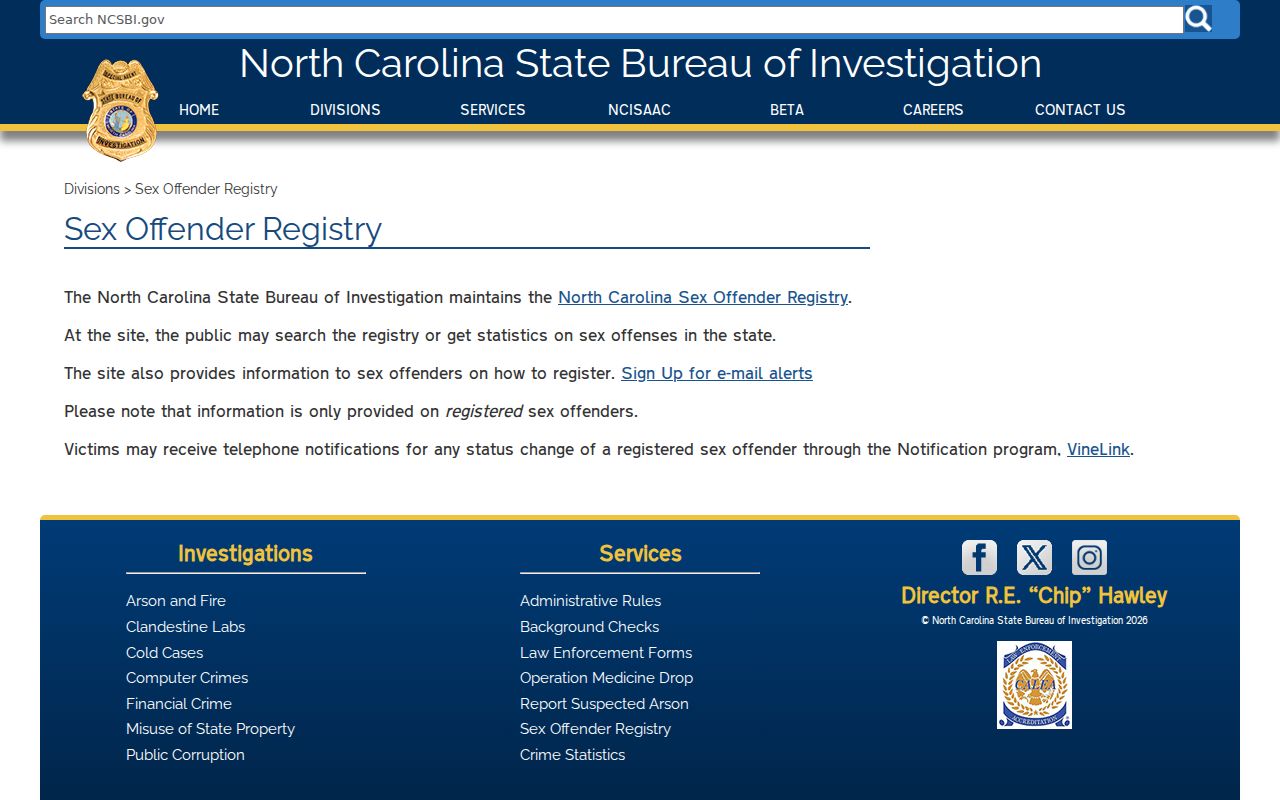
This state program view shows how Chatham County registration work connects to the SBI-maintained public registry.
How to Search the North Carolina Sex Offender and Public Protection Registry
Use the official North Carolina Sex Offender and Public Protection Registry for the primary Chatham County state search. The interface supports name and geographic routes. Searchers can look near an address, narrow by city or ZIP, use latitude and longitude where offered, or enter a Sex Registration Number. Email-alert enrollment provides a continuing watch around a chosen location. Available distance controls should be checked on the live form because interfaces can change.
- Open the state registry and read its conditions, scope, and accuracy limits.
- Choose a name search or an address-based route. Add Chatham County city or ZIP details to narrow a broad result.
- Compare aliases, photograph, physical description, address, status, and registration number before treating a record as a match.
- Open the full profile, note its offense and status details, and contact the Chatham registration line when local information appears wrong.
| Search Route or Field | Type | Required | Notes |
|---|---|---|---|
| Offenders near an address | Address and radius | Location | Uses street, city, ZIP, and offered distance controls. |
| Name | Text | Search-dependent | Add city or ZIP to reduce common-name matches. |
| City | Text or dropdown | Optional | Limits results by locality. |
| ZIP code | Text | Optional | Uses a five-digit ZIP. |
| Latitude / longitude | Numeric or geographic | Route-dependent | Alternative geographic search. |
| Sex Registration Number | Text | Alternative | Direct identifier search. |
| Email alerts | Enrollment | Contact and address | Proximity or change notification channel. |
Search more than one way when location facts may have changed. A name query can find records outside one ZIP, while an address search can reveal registrants near a place even when their city label differs. Save the registration number from a likely result before contacting the Chatham County registry office.
Chatham Registry Identity Checks
A matching name in a Chatham County search is not fingerprint identification. Aliases, similar names, address changes, and self-reported details can produce uncertainty. Compare the photograph and physical description with the record's registration number, address, qualifying conviction, and jurisdiction. Do not infer that a person is absent from the legal registry population simply because one spelling or ZIP search returns nothing.
The official SBI registry FAQ explains the database's limits, reporting path, lawful use, and need to verify information.
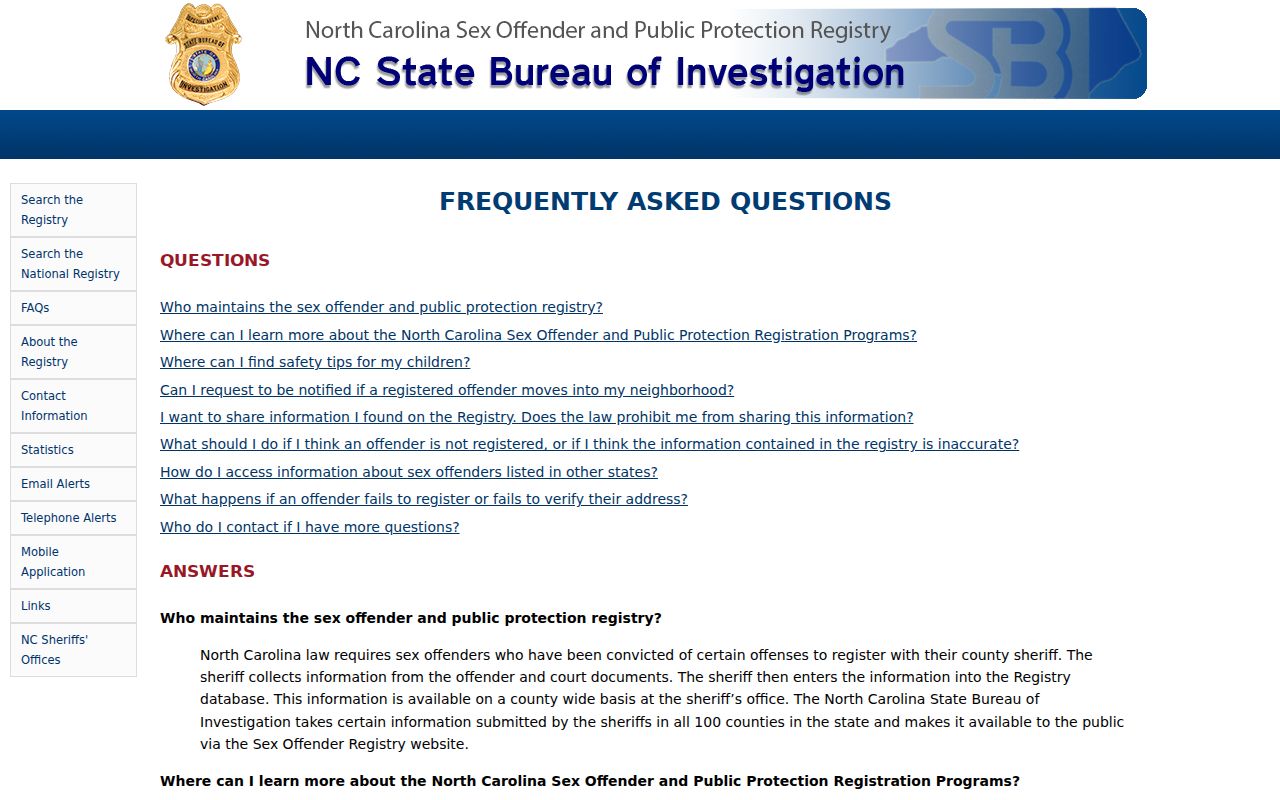
The FAQ view is a useful reminder that Chatham County registry results support awareness but do not replace fingerprint-based identity confirmation.
Note: If a Chatham listing appears inaccurate, save the registration number and disputed field before contacting the Sheriff's registration office.
Inside a Registry Profile
A Chatham County public profile may display a photograph, registered name, aliases, sex registration number, and physical descriptors such as race, sex, height, weight, hair, and eyes. Age or date-of-birth information appears only as permitted. Address and status fields show where the person reports living and their current registry standing. The offense area can include the qualifying offense, conviction date, jurisdiction, and statute or description. Other authorized fields may cover marks, vehicles, work, or education.
| Name & Aliases | Registered identity plus alternate names published by the state. |
|---|---|
| Photo & Description | Photograph and authorized physical traits used to compare a possible match. |
| Registered Address | The public address information reported and verified under state rules. |
| Offense & Statute | Qualifying conviction details, jurisdiction, date, and legal description when shown. |
| Registration Number | A direct identifier that can separate similar names. |
| Status | Current registration information and other authorized status details. |
The SBI registry history and purpose page gives context for why North Carolina publishes this limited set of information.
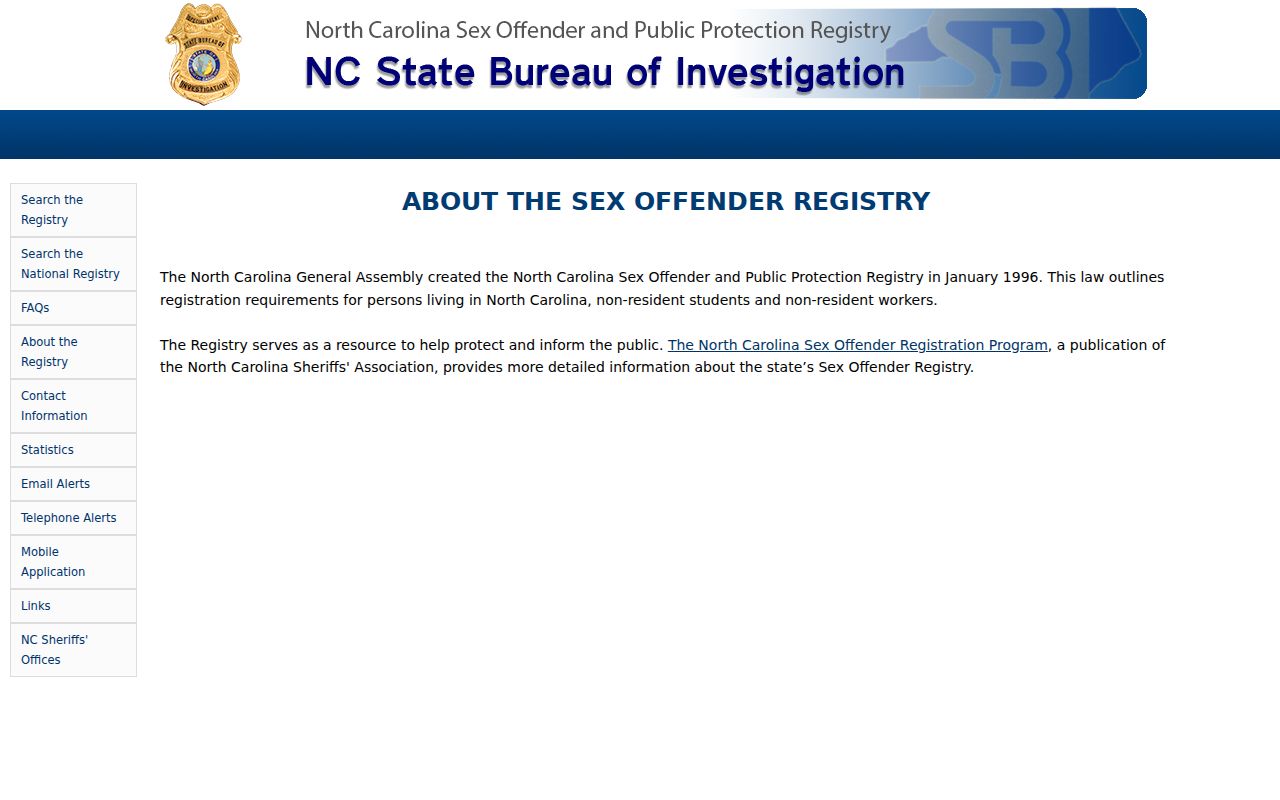
That purpose matters when reading a Chatham County profile: public fields are selected for community notice, not as a complete criminal-history file.
Chatham Registry Alerts and NSOPW
The North Carolina registry offers Chatham County email alerts tied to an address or area. These alerts help residents track changes without repeating the same map search. NC SAVAN and VINELink can provide other notification functions where supported, but those systems serve different custody or status questions. Keep the alert type clear. A registry proximity alert is not the same as notice that someone has left county custody.
Add the U.S. Department of Justice National Sex Offender Public Website when a search crosses state lines or when Chatham County is only one part of the location history.
NSOPW federates participating jurisdictions, which makes it a useful second layer rather than a replacement for the detailed North Carolina record.
North Carolina Registration Levels and Requirements
For Chatham County, North Carolina does not publish a simple Tier I, Tier II, and Tier III table like many commercial summaries use. Article 27A classifications control duties and duration. The baseline state program commonly requires registration for 30 years, with a possible petition for termination after the statutory minimum. Recidivists, aggravated offenders, and sexually violent predators can face lifetime registration. Verification can be semiannual or every 90 days depending on the legal category.
| North Carolina Category | Duration | Verification Pattern |
|---|---|---|
| Baseline state program | Commonly 30 years; petition may be possible after the statutory minimum | Semiannual verification applies in the ordinary category |
| Recidivist or aggravated category | Lifetime registration may apply | More frequent 90-day verification can apply |
| Sexually violent predator | Lifetime registration may apply | More frequent 90-day verification can apply |
Satellite-based monitoring is a separate legal determination. It should never be inferred from a public profile or a registration-duration label. Consult current North Carolina Article 27A for exact category, verification, duration, and petition rules.
Chatham Registry Duration Rules
In a Chatham County search, a 30-year registration period does not mean every person leaves the registry automatically on one date. A qualifying person may need to petition after the statutory minimum, and the court applies current law to the facts. Lifetime categories work differently. The offense, conviction history, legal classification, and later orders all matter. Registry status should therefore be read from the current profile and source law, not guessed from the age of a conviction.
North Carolina also restricts where certain registrants may reside. Article 27A includes a 1,000-foot rule measured from the property line of certain schools and child-care centers. The exact coverage and exceptions are legal questions. A map pin alone does not establish compliance because property boundaries, facility status, and the person's category can matter. Chatham County residents should report a concrete concern to the registration office, which can check source records and legal status. Satellite-based monitoring should not be presumed from an address, map result, registration term, or public profile field.
Chatham Registry Errors and Compliance
SBI notes that some registry details are self-reported and can change fast. If an address, status, or identifying fact looks wrong, use the Chatham County registration line rather than confronting the listed person. Give staff the sex registration number, the field at issue, and the basis for the concern. The sheriff verifies local registrations and sends information into the state system, while SBI maintains the public database.
For Chatham County registrants, North Carolina treats failures to register, report an address change, return verification, or provide truthful information as serious offenses that can be charged as a Class F felony. A public search result cannot determine whether a violation has occurred. Report a suspected compliance problem to the registration office and let the responsible agency investigate it.
Community Notification and Lawful Use
Registry information supports personal, family, neighborhood, and community awareness. Use it to review nearby results, enroll in alerts, plan safety talks, and pass a good-faith accuracy concern to the sheriff. It cannot measure all community risk. The database omits people who are not legally required to register, confidential juvenile matters, and unreported or unresolved conduct. A profile also does not predict future behavior.
Misuse is a crime: North Carolina warns that threats, intimidation, stalking, or harassment based on registry data may lead to prosecution; consult Article 27A.
Do not publish private commentary about a listed person, visit an address to investigate, or attempt to enforce registration rules. Contact Chatham County's registration office for local questions. Use 911 only for an emergency or immediate danger.